

The Sweet Place
What Your Sacral Chakra Is Telling You About Your Creative Flow

This article is written by Kyle Fisk - a graduate of The Creator Retreat who now offers Theta Healing to the Creator Retreat Participants.
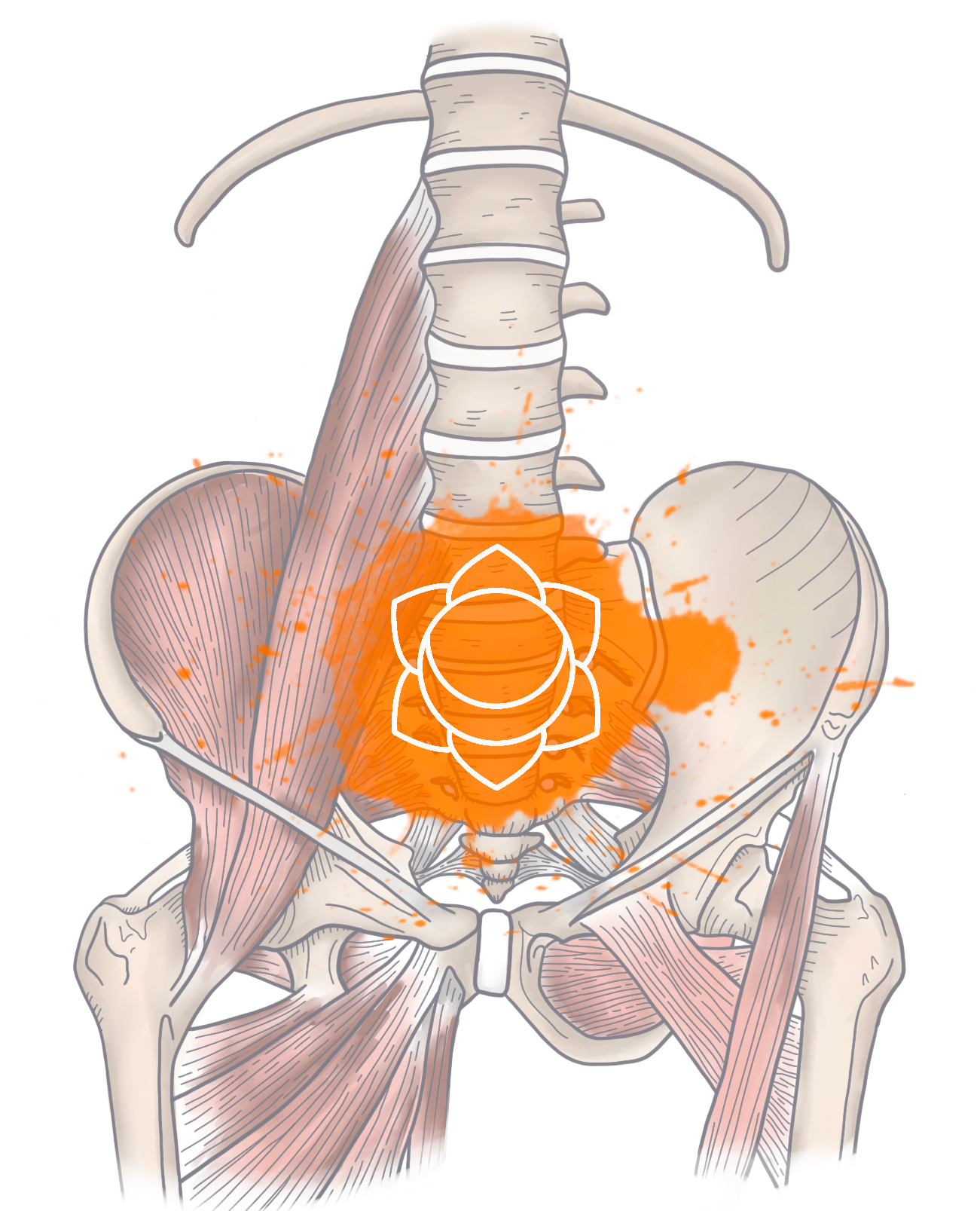
The sacral chakra has a name that I love: the Sweet Place. It occupies your pelvic bowl where the organs live that are designed for holding something for a time and then letting go, receiving and releasing. And significantly, the sacral chakra is governed by water — the element of movement, flexibility, and flow. It’s the energy center of creation itself.
[This month, in Teri Leigh’s Creator Retreat program, we’re learning that,] if you’re a creator, this chakra is basically your home base. Every time you sit down to write, paint, record, or build something new, you’re drawing from this well. So when it’s out of balance, you feel it — not just emotionally, but in your body. And your body is always trying to tell you something.
Here’s what I’ve learned, both through my own life and through the clients I work with: physical tightness or instability is rarely “just physical.” It’s often a set of beliefs, lodged in the body since a specific experience, designed to protect you, and still running in the background like old software.
When the Hips Lock Up: Fear of Change
The hips are what move us forward. When they’re rigid, it signals fear of change. When they’re unstable, it signals fear of commitment. When they ache, it’s worth asking: what am I trying not to move toward?
After my friend Kendra passed away last year — something I wrote about in “Rooted, Rattled, Restored” — I noticed a tightness in my hips that hadn’t been there before. It wasn’t subtle. My body was holding the question I couldn’t yet ask out loud: How do I live without her? I don’t know how to move forward into a life that looks different than the one I had.
That’s fear of change, stored in the joints that are designed to carry us forward. And it registered in my body and in the stagnation of creative work in the months following.
For creators, this might also show up as the project you won’t finish because finishing means it’s real, the new direction you won’t try because it might mean leaving the old one behind, or the niche you won’t commit to because committing feels like closing a door. Your hips might be the first place you feel it before your mind catches up.
Creating From Surrender, Not Force
The reproductive organs are where we birth joy and creation. And here’s the thing about that process — it has never, in the history of anything, responded well to force.
You cannot force a baby to be born before it’s ready. You cannot force a seed to bloom faster by pulling on it. And you cannot force your best creative work into existence by gripping it harder. Force doesn’t create. It controls.
Compelling creativity requires surrender. Not passivity — surrender. There’s a difference between giving up and opening your hands. When we create from force, the work often feels heavy, both to make and to receive. When we create from surrender — trusting the process, trusting the timing, trusting that the idea will come when it’s ready — the work moves through us instead of being dragged out of us.
What We Hold In: The Bladder
The bladder lives in the realm of the sacral chakra, too, and holds our emotional fluid. Hold it too long, and we get overwhelmed. Release it too soon, and we leak — emotionally reactive, unable to contain what’s ours to process privately.
My third son wet the bed until he was about ten. Back then, we’d just begun to learn about the emotional roots of physical symptoms, and we came to understand what was happening for him. The youngest of our three boys, he often felt left behind, unable to keep up, never enough. And when his older brothers mocked him for showing anger, he learned that anger wasn’t safe to express. So he held it in. All day. And at night, when his body finally relaxed into sleep, what he’d been holding all day released too — through his bladder.
Once we cleared the anger itself, and the underlying beliefs about who he was allowed to be in his family, the bedwetting stopped. The body had simply been doing what it was told: hold this in; it isn’t safe to let it out.
If you’re a creator who has ever sat on a finished piece of work for months because putting it out into the world felt unsafe — too exposing, too likely to be mocked or dismissed — this is the same pattern. Something in you learned, a long time ago, that what you have to express isn’t welcome. The work you’re holding back isn’t actually about the work. It’s about whether you believe you’re allowed to take up space.
Discernment: The Large Intestine
The large intestine’s job is to discern wisdom from waste. When it’s healthy, letting go is a satisfying, embodied release — not everything that comes in is meant to stay.
We’re already constantly making these calls: what to keep, what to release, what feedback to take in, what ideas to act on. But most of us are making these decisions from old, ego-based programming, the survival rules learned by a younger version of us who didn’t have much information but installed the rules because it kept us safe at the time.
For creators, two patterns show up here, just like the physical symptoms of the body:
Constipation — holding onto something out of a need for control, or a fear of letting go. This is the draft you’ve revised forty times. The idea you’re sitting on because releasing it means it’s no longer fully yours to control.
Or the other extreme, Diarrhea — too little control, refusing to hold onto even what you need. This is jumping from project to project, never finishing, scattering your energy because committing, staying with something, feels like getting stuck.
That programming is old code still running quietly in the background, on outdated hardware. But the system that kept you safe at seven isn’t built for the life you’re creating at forty. Through my healing practice, using the ThetaHealing® protocols, I’ve learned that we can download new instructions for wiser discernment, like updating a computer’s operating system.
When we shift into making these calls from a higher perspective — from the soul’s view, from Creator’s view — discernment stops being driven by fear and starts being driven by clarity.
A Better Way: Going With the Flow
Going with the flow doesn’t mean being swept under. It means learning to read the water. Wise discernment plus going with the flow is like navigating a river. You’re not trying to stop the water or force it in a different direction. You’re paying attention, noticing the submerged obstacles, choosing when to steer around them and when to find your way through. The general direction of the river isn’t yours to control. Your relationship to it is.
That’s the sweet spot. Neither gripping, nor abandoning ship. You’re discerning, from a higher perspective, what’s actually yours to hold and releasing the rest.
Questions Worth Sitting With
Your body has been keeping notes your whole life. The Sweet Place is just asking you to read them. Here are Teri Leigh’s questions that might help you learn what your sacral chakra is expressing:
Where am I unwilling — or unable — to go with the flow?
Where am I gripping too tightly?
Where do I feel stuck?
What am I holding onto that needs to be released or expressed?
Is there an imbalance between work and play, responsibility and relaxation? Or, am I balanced by swinging between extremes?
Can I release control and still move forward?
These Sweet Spot themes — control, learning to gently balance joy and guilt, work and play, holding on and letting go — will eventually become a guided video healing session, too. Stay tuned! Meanwhile, if you’d like to learn more about how I could help you individually, here’s a link to schedule a consultation:
The chakra information and reflection questions in this post draw on Teri Leigh’s book The Goldilocks Principle: A Practical Guide to the Chakras*, as well as her teachings on the chakra system through The Creator Retreat program.*

The Creator Retreat is a quiet community for sensitive souls to create. We offer a 10-month cohort program annually, with a self-study option available. Our next cohort application will open in January 2027.
Great job Kyle! Well written and very insightful……